
LAND OF INK AND THE TEA ROAD
From Mountain Scrolls to Hakka Houses
A cultural journey into the heart of living China, across a land of mountains, enduring traditions, and age-old gestures passed down through generations. This is a path of learning and sharing, shaped by close encounters with local communities and their rich heritage. Through daily life, craftsmanship, and ancestral practices, travelers are invited to slow down and truly connect. Here, every moment becomes an exchange, every meeting a dialogue, and every place a world to be discovered from within.
Day 1 Shanghai
Arrival in Shanghai. Visit the Yu Garden, with its carp-filled ponds, elegant pavilions, rockeries, and bamboo groves. Explore the historic Chenghuangmiao Old Town. Stroll along the Bund, lining the Huangpu River and bordered by iconic buildings from the concession era. Dinner featuring Xiaolongbao, Shanghai’s speciality.
Arrival in Shanghai. Visit the Yu Garden, with its carp-filled ponds, elegant pavilions, rockeries, and bamboo groves. Explore the historic Chenghuangmiao Old Town. Stroll along the Bund, lining the Huangpu River and bordered by iconic buildings from the concession era. Dinner featuring Xiaolongbao, Shanghai’s speciality.
Day 2 Shanghai → Hangzhou
Green Tea: Longjing
Departure for Hangzhou, considered one of China’s earthly paradises. Travel to Longjing Tea Village, renowned for producing one of China’s finest and most prestigious green teas. Visit the Eighteen Imperial Tea Trees of Emperor Qianlong. Return to Hangzhou and visit the Huqingyu Tang Museum of Traditional Chinese Medicine, discovering its pharmacopoeia and still-functioning pharmacy. Walk around the famous West Lake, surrounded by hills crowned with pagodas. In the evening, enjoy squirrel-shaped fish, a renowned Hangzhou specialty, accompanied by Longjing tea.
Green Tea: Longjing
Departure for Hangzhou, considered one of China’s earthly paradises. Travel to Longjing Tea Village, renowned for producing one of China’s finest and most prestigious green teas. Visit the Eighteen Imperial Tea Trees of Emperor Qianlong. Return to Hangzhou and visit the Huqingyu Tang Museum of Traditional Chinese Medicine, discovering its pharmacopoeia and still-functioning pharmacy. Walk around the famous West Lake, surrounded by hills crowned with pagodas. In the evening, enjoy squirrel-shaped fish, a renowned Hangzhou specialty, accompanied by Longjing tea.
Day 3 Hangzhou → Xidi Village → Tunxi (High-Speed Train)
High-speed train to Tunxi, followed by a visit to Xidi Village (UNESCO), founded during the Song dynasty and famous for its traditional Huizhou architecture: whitewashed walls, black-tiled roofs, inner courtyards, and finely carved wood, stone, and brick decorations. Discover the Hu Family commemorative archway, stone bridges, and cobbled lanes. Dinner featuring Huizhou cuisine, refined yet rustic, highlighting local ingredients.
High-speed train to Tunxi, followed by a visit to Xidi Village (UNESCO), founded during the Song dynasty and famous for its traditional Huizhou architecture: whitewashed walls, black-tiled roofs, inner courtyards, and finely carved wood, stone, and brick decorations. Discover the Hu Family commemorative archway, stone bridges, and cobbled lanes. Dinner featuring Huizhou cuisine, refined yet rustic, highlighting local ingredients.
Day 4 Tunxi → Yellow Mountains → Tangmo Village
Full-day excursion to the Yellow Mountains (Huangshan) (UNESCO), a timeless source of inspiration for China’s greatest painters and poets. Ascend by cable car to admire granite peaks rising above seas of clouds, covered with centuries-old pine forests. Overnight in a charming hotel in the traditional village of Tangmo.
Full-day excursion to the Yellow Mountains (Huangshan) (UNESCO), a timeless source of inspiration for China’s greatest painters and poets. Ascend by cable car to admire granite peaks rising above seas of clouds, covered with centuries-old pine forests. Overnight in a charming hotel in the traditional village of Tangmo.
Day 5 Tangmo → Chengkan → Lingcun
Green Tea: Maofeng
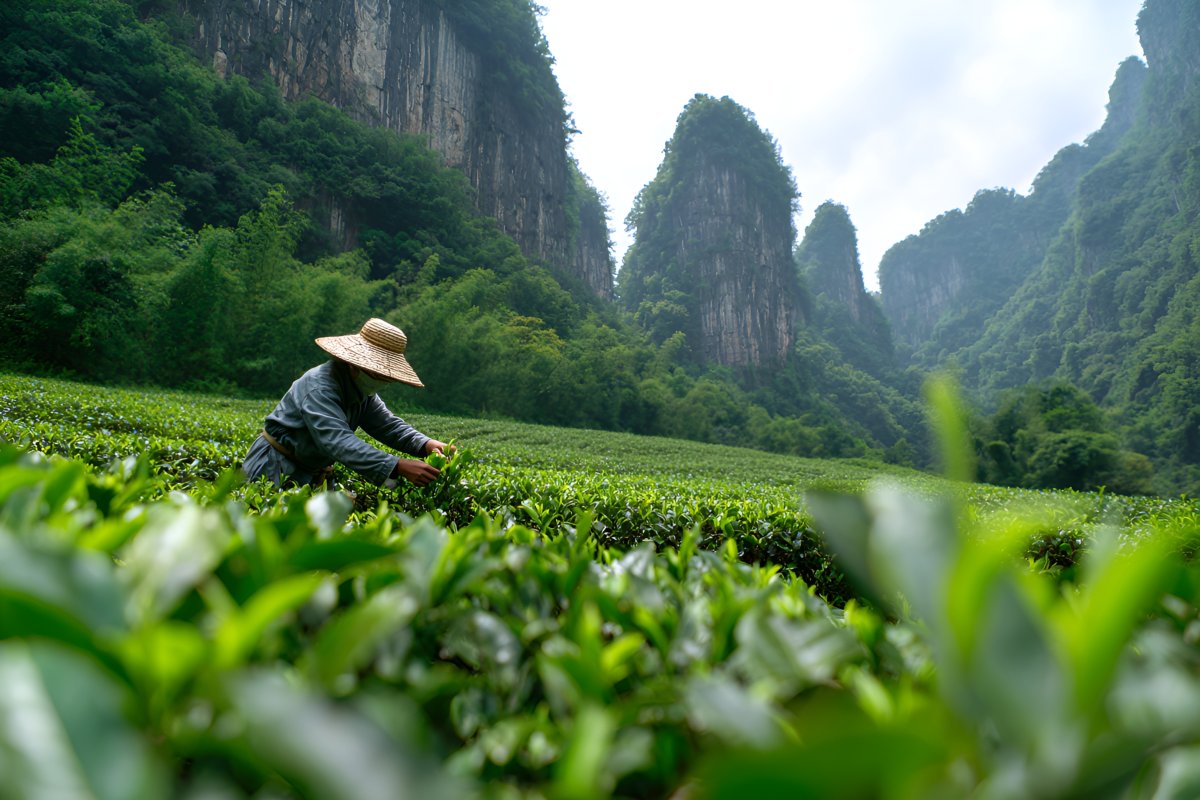
Explore Tangmo Village, founded during the Tang dynasty and far from mass tourism, an ideal place to appreciate the poetic harmony of Huizhou villages combining water, traditional houses, and mountains. Participate in a stone inscription rubbing workshop, using traditional techniques to reproduce carved steles: paper dampening, ink padding, and revealing calligraphic characters. Visit a Maofeng green tea plantation, learning about hand-picking, withering, wok-heating to stop oxidation, rolling, and gentle drying. Lunch with a rural family. Visit a family workshop and learn the basics of bamboo weaving. End the day with a visit to Chengkan Village, over 1,800 years old, renowned for its sophisticated feng shui layout based on the Eight Trigrams.
Green Tea: Maofeng
Explore Tangmo Village, founded during the Tang dynasty and far from mass tourism, an ideal place to appreciate the poetic harmony of Huizhou villages combining water, traditional houses, and mountains. Participate in a stone inscription rubbing workshop, using traditional techniques to reproduce carved steles: paper dampening, ink padding, and revealing calligraphic characters. Visit a Maofeng green tea plantation, learning about hand-picking, withering, wok-heating to stop oxidation, rolling, and gentle drying. Lunch with a rural family. Visit a family workshop and learn the basics of bamboo weaving. End the day with a visit to Chengkan Village, over 1,800 years old, renowned for its sophisticated feng shui layout based on the Eight Trigrams.
Day 6 Tangmo → Jingdezhen (High-Speed Train)
High-speed train to Jingdezhen, the historic capital of Chinese porcelain, which flourished under the Song, Yuan, Ming, and Qing dynasties and served as the official supplier to the imperial court. Visit the Porcelain Museum, showcasing masterpieces from the Tang to Qing dynasties, including imperial wares and famous techniques such as Qinghua (blue-and-white), famille rose, and multicolored enamels. Visit a village of contemporary ceramic artisans, exploring workshops, markets, and artist residences.
High-speed train to Jingdezhen, the historic capital of Chinese porcelain, which flourished under the Song, Yuan, Ming, and Qing dynasties and served as the official supplier to the imperial court. Visit the Porcelain Museum, showcasing masterpieces from the Tang to Qing dynasties, including imperial wares and famous techniques such as Qinghua (blue-and-white), famille rose, and multicolored enamels. Visit a village of contemporary ceramic artisans, exploring workshops, markets, and artist residences.
Day 7 Jingdezhen → Mount Wuyi
Visit the Folk Ceramics Museum, offering a vivid demonstration of traditional ceramic techniques: clay refining, shaping, carving, decorative painting, glazing, and kiln firing. Free time at the porcelain market. Late-afternoon high-speed train to Mount Wuyi (UNESCO).
Visit the Folk Ceramics Museum, offering a vivid demonstration of traditional ceramic techniques: clay refining, shaping, carving, decorative painting, glazing, and kiln firing. Free time at the porcelain market. Late-afternoon high-speed train to Mount Wuyi (UNESCO).
Day 8 Mount Wuyi
Local Tea: Oolong (Semi-Fermented Tea)
Excursion to Wuyishan National Park, including a bamboo raft ride along the Nine-Bend River. Afternoon visit to the legendary Dahongpao Tea Garden, walking through tea plantations and dramatic rock formations, discovering ancient tea bushes and the famous Da Hong Pao tea. Optional evening performance: Impression Dahongpao, directed by Zhang Yimou, an immersive show celebrating tea culture in the majestic natural setting of Mount Wuyi (payable locally).
Local Tea: Oolong (Semi-Fermented Tea)
Excursion to Wuyishan National Park, including a bamboo raft ride along the Nine-Bend River. Afternoon visit to the legendary Dahongpao Tea Garden, walking through tea plantations and dramatic rock formations, discovering ancient tea bushes and the famous Da Hong Pao tea. Optional evening performance: Impression Dahongpao, directed by Zhang Yimou, an immersive show celebrating tea culture in the majestic natural setting of Mount Wuyi (payable locally).
Day 9 Mount Wuyi → Xiamei Village → Xiamen
Local Tea Experience: Diancha Workshop
Tea-making workshop discovering traditional production stages, the art of the tea master, and the importance of climate. Introduction to Diancha (点茶), an intangible cultural heritage dating back to the Tang dynasty. Visit Xiamei Village, which prospered during the Ming and Qing dynasties through the tea trade. Walk through the village built along both sides of the river, discovering traditional houses, stone bridges, and finely decorated pavilions. High-speed train to Xiamen. Dinner featuring Fujian cuisine, one of China’s eight great culinary traditions, accompanied by Oolong tea.
Local Tea Experience: Diancha Workshop
Tea-making workshop discovering traditional production stages, the art of the tea master, and the importance of climate. Introduction to Diancha (点茶), an intangible cultural heritage dating back to the Tang dynasty. Visit Xiamei Village, which prospered during the Ming and Qing dynasties through the tea trade. Walk through the village built along both sides of the river, discovering traditional houses, stone bridges, and finely decorated pavilions. High-speed train to Xiamen. Dinner featuring Fujian cuisine, one of China’s eight great culinary traditions, accompanied by Oolong tea.
Day 10 Xiamen → Chuxi Tulou
Drive to Yongding, crossing banana groves, sugarcane fields, lychee orchards, and orange trees. Visit the Hakka Tulou (UNESCO), traditional fortified communal dwellings. Arrive in Chuxi Village, surrounded by mountains and terraced rice fields. Discover five circular and twelve rectangular tulou harmoniously set within the landscape. Visit Jiqinglou and Shanqinglou. Dinner featuring Hakka red rice wine–marinated pork ribs, a local specialty. Overnight in a traditional Tulou guesthouse.
Drive to Yongding, crossing banana groves, sugarcane fields, lychee orchards, and orange trees. Visit the Hakka Tulou (UNESCO), traditional fortified communal dwellings. Arrive in Chuxi Village, surrounded by mountains and terraced rice fields. Discover five circular and twelve rectangular tulou harmoniously set within the landscape. Visit Jiqinglou and Shanqinglou. Dinner featuring Hakka red rice wine–marinated pork ribs, a local specialty. Overnight in a traditional Tulou guesthouse.
Day 11 Tianluokeng Tulou Cluster
Morning visit to the Tianluokeng Tulou, known as the “Golden Flower of the Earth,” with one square tulou surrounded by four circular ones. Visit Yuchanglou. Discover Taxia Village, founded in the 15th century during the Ming dynasty, an exceptional example of traditional rural planning with over 40 rectangular and oval tulou. Cooking workshop: preparation of Yuzibao, a local stuffed bun, followed by tasting. Visit Yunshuiyao Village, part of the ancient tea and salt trade route. Discover Heguilou, a five-story tulou surrounded by water, and Huaiyuanlou, formerly a Confucian school.
Morning visit to the Tianluokeng Tulou, known as the “Golden Flower of the Earth,” with one square tulou surrounded by four circular ones. Visit Yuchanglou. Discover Taxia Village, founded in the 15th century during the Ming dynasty, an exceptional example of traditional rural planning with over 40 rectangular and oval tulou. Cooking workshop: preparation of Yuzibao, a local stuffed bun, followed by tasting. Visit Yunshuiyao Village, part of the ancient tea and salt trade route. Discover Heguilou, a five-story tulou surrounded by water, and Huaiyuanlou, formerly a Confucian school.
Day 12 Hongkeng → Xiamen
Visit Zhenchenglou, built in 1912 and known as the “Prince of Tulou,” featuring 222 rooms within its concentric rings. Return to Xiamen and excursion to Gulangyu Island, strolling through lanes lined with colonial villas, old banyan trees, and historic remains.
Dinner featuring satay noodles, lychee-style pork, and oyster omelet, specialties of Xiamen.
Visit Zhenchenglou, built in 1912 and known as the “Prince of Tulou,” featuring 222 rooms within its concentric rings. Return to Xiamen and excursion to Gulangyu Island, strolling through lanes lined with colonial villas, old banyan trees, and historic remains.
Dinner featuring satay noodles, lychee-style pork, and oyster omelet, specialties of Xiamen.
Day 13 Xiamen
Visit Nanputuo Temple, founded during the Tang dynasty and dedicated to Maitreya (the Future Buddha), still an active place of worship. Walk through Local Market No. 8 in the Lujiangdao district.
Visit Nanputuo Temple, founded during the Tang dynasty and dedicated to Maitreya (the Future Buddha), still an active place of worship. Walk through Local Market No. 8 in the Lujiangdao district.