
YUNNAN SECRET
Between Ethnic Cultures, Sacred Valleys, and Authentic Villages
Through this remarkable journey, you will experience powerful moments and discover a living, fertile, and resilient Yunnan. From millennia-old terraced rice fields to vibrant village markets off the beaten path, you will meet the people who inhabit these lands—those who cultivate them, preserve ancestral knowledge, and reinvent agriculture in balance with nature. Immersed in daily life and shared traditions, each step becomes an encounter, each stop a moment of reflection, and the journey itself a deeper understanding of a land shaped by solidarity, respect, and continuity.
Day 1 Paris → Kunming
Departure from Paris to Kunming with one stopover.
Meals and overnight on board.
Departure from Paris to Kunming with one stopover.
Meals and overnight on board.
Day 2 Kunming (1,800 m altitude)
After your stopover, arrival in Kunming, capital of Yunnan, known as the City of Eternal Spring. Welcome by your national French-speaking guide, transfer into the city for lunch, then check-in at your hotel. Leisure stroll through the flower and bird markets in the old traditional districts. Discover the Jinma–Biji Gate and the Dongtasi Pagoda, iconic symbols of the city.
After your stopover, arrival in Kunming, capital of Yunnan, known as the City of Eternal Spring. Welcome by your national French-speaking guide, transfer into the city for lunch, then check-in at your hotel. Leisure stroll through the flower and bird markets in the old traditional districts. Discover the Jinma–Biji Gate and the Dongtasi Pagoda, iconic symbols of the city.
Day 3 Kunming → Shilin → Mile (90 km / 1h20 – 65 km / 1h20)
Visit the Haigeng Ethnic Minorities Museum, showcasing the traditions, customs, and costumes of Yunnan’s diverse ethnic groups. Travel by coach to the impressive Naigu Black Stone Forest (Heishilin), a UNESCO-listed natural wonder. Walk through this unique karst landscape, away from the main tourist crowds. Continue to Mile, stopping at Keyi Village, home to the Ahxi, a branch of the Yi people, known for their rich ethnic culture and picturesque scenery.Day 4 Mile → Yuanyang (1,800 m altitude) (200 km / 2h30)
Morning departure for Yuanyang (UNESCO), perched at 1,800 meters above sea level. Emerging from mist and clouds, the Hani terraced rice fields, shaped over centuries, stretch endlessly across the hills—one of Yunnan’s most spectacular landscapes.
En route, discover vineyards introduced from Bordeaux by a French missionary. Board a short journey on the historic Yunnan–Vietnam narrow-gauge railway, built by the French in 1910, from Qikongqiao to Kaiyuan. Continue to Shadian to visit the largest mosque in Yunnan. Stop along the Red River and stroll through a lively local market filled with exotic fruits. Arrival in Yuanyang in the late afternoon to admire the sunset over the terraced fields at Bada Village.
Morning departure for Yuanyang (UNESCO), perched at 1,800 meters above sea level. Emerging from mist and clouds, the Hani terraced rice fields, shaped over centuries, stretch endlessly across the hills—one of Yunnan’s most spectacular landscapes.
En route, discover vineyards introduced from Bordeaux by a French missionary. Board a short journey on the historic Yunnan–Vietnam narrow-gauge railway, built by the French in 1910, from Qikongqiao to Kaiyuan. Continue to Shadian to visit the largest mosque in Yunnan. Stop along the Red River and stroll through a lively local market filled with exotic fruits. Arrival in Yuanyang in the late afternoon to admire the sunset over the terraced fields at Bada Village.
Day 5 Yuanyang
A full day dedicated to discovering ethnic minorities and the most beautiful terraced rice fields in China.
Enjoy an easy hike at your own pace along the rice-field paths from Shencun Village to Quanfu Village (1–3 hours depending on pace). Visit the Hani village of Jingkou. End the day at Laohuzui, the finest viewpoint to admire the magnificent sunset over the terraces.
A full day dedicated to discovering ethnic minorities and the most beautiful terraced rice fields in China.
Enjoy an easy hike at your own pace along the rice-field paths from Shencun Village to Quanfu Village (1–3 hours depending on pace). Visit the Hani village of Jingkou. End the day at Laohuzui, the finest viewpoint to admire the magnificent sunset over the terraces.
Day 6 Yuanyang → Xinjie Village → Jianshui (150 km / 2h30)
Visit the bustling morning market of Xinjie, discovering local products and colorful traditional ethnic textiles. Continue to Jianshui, a political and military center during the 13th century under the Yuan dynasty, renowned for its exceptionally preserved architecture built by Hui artisans and soldiers. Visit Tuanshan Village, the Double Dragon Bridge, and the Zhang Family Residence, an elegant late-19th-century complex adorned with finely carved wooden screens, decorated lintels, and friezes depicting mythical creatures. Evening walk in Jianshui’s old town to discover the Chaoyang Pavilion and ancient wells.Day 7 Jianshui → Kunming → Weishan (180 km / 2h30)
Visit the Zhu Family Garden Residence, a grand estate of nearly two hectares built at the end of the Qing dynasty. Visit the Confucius Temple (Wenmiao), originally built in 1285 during the Mongol period.
Visit a traditional tofu workshop. Transfer to Kunming railway station, passing three high-altitude lakes en route. High-speed train to Weishan (second class). Arrival in Weishan, former capital of the Nanzhao Kingdom, home to numerous ethnic groups (Yi, Hui, Bai, Miao). Hotel check-in.
Visit a traditional tofu workshop. Transfer to Kunming railway station, passing three high-altitude lakes en route. High-speed train to Weishan (second class). Arrival in Weishan, former capital of the Nanzhao Kingdom, home to numerous ethnic groups (Yi, Hui, Bai, Miao). Hotel check-in.
Day 8 Weishan → Dali (2,000 m altitude) (70 km / 1h30)
Morning walk through Weishan Old Town, dating back to the late Ming dynasty, including city walls, markets, and the Gongcheng and Xinggong pavilions.
Visit Weibaoshan Mountain, the largest Taoist center in southwest China. A 2-hour hike leads you to temples dedicated to scholars, princes, and the Jade Emperor. Drive to Dali, stopping at Donglianhua (“Eastern Lotus”), a charming Hui village on the ancient Tea and Horse Road. Arrival in Dali, former capital of the Nanzhao and Dali kingdoms, renowned for its marble. Walk through the old town, discovering the Catholic church, South Gate, and the pedestrian Foreigner Street.
Morning walk through Weishan Old Town, dating back to the late Ming dynasty, including city walls, markets, and the Gongcheng and Xinggong pavilions.
Visit Weibaoshan Mountain, the largest Taoist center in southwest China. A 2-hour hike leads you to temples dedicated to scholars, princes, and the Jade Emperor. Drive to Dali, stopping at Donglianhua (“Eastern Lotus”), a charming Hui village on the ancient Tea and Horse Road. Arrival in Dali, former capital of the Nanzhao and Dali kingdoms, renowned for its marble. Walk through the old town, discovering the Catholic church, South Gate, and the pedestrian Foreigner Street.
Day 9 Dali → Xizhou Village → Shaxi (150 km / 2h15)
Visit the Chongsheng Temple and its elegant Three Pagodas, the symbol of Dali. Continue to Xizhou, a historic Bai village near Erhai Lake, known for its traditional architecture and peaceful atmosphere. Explore the lively market. Visit the Yan Family Residence, once home to wealthy merchants, and a traditional tie-dye workshop, a craft still practiced by the Bai people. Drive to Shaxi, an ancient stop on the Tea and Horse Road. Overnight in Shaxi.Day 10 Shaxi → Jianchuan → Zhongdian (Shangri-La) (3,160 m altitude) (225 km / 4h)
Walk through Sideng Village, visiting Xingjiao Temple, the ancient theater, Sifangjie Square, and Yujin Bridge. Drive toward Zhongdian, a Tibetan town in northern Yunnan, known as Shangri-La, “the land of peace and serenity.” On this high plateau, buffalo in rice fields coexist with grazing yaks.
Stop in Jianchuan Old Town, with its Ming and Qing houses and cobbled streets. Arrival and overnight in Zhongdian.
Walk through Sideng Village, visiting Xingjiao Temple, the ancient theater, Sifangjie Square, and Yujin Bridge. Drive toward Zhongdian, a Tibetan town in northern Yunnan, known as Shangri-La, “the land of peace and serenity.” On this high plateau, buffalo in rice fields coexist with grazing yaks.
Stop in Jianchuan Old Town, with its Ming and Qing houses and cobbled streets. Arrival and overnight in Zhongdian.
Day 11 Zhongdian (Shangri-La)
Visit Songzanlin Monastery, one of the 13 major monasteries of the Gelugpa (Yellow Hat) school, founded in 1679 by the 5th Dalai Lama, often called the Little Potala. Walk along Napa Lake, admiring seasonal wetlands, lush pastures, and surrounding villages. Visit a local market and stroll through the Tibetan old town. Discover a Thangka painting gallery, showcasing traditional Tibetan religious art.
Climb Turtle Back Hill for panoramic views over Dukezong Ancient Town. Visit a Tibetan village, meet a local family, taste yak butter tea, and enjoy a traditional home-cooked meal.
Visit Songzanlin Monastery, one of the 13 major monasteries of the Gelugpa (Yellow Hat) school, founded in 1679 by the 5th Dalai Lama, often called the Little Potala. Walk along Napa Lake, admiring seasonal wetlands, lush pastures, and surrounding villages. Visit a local market and stroll through the Tibetan old town. Discover a Thangka painting gallery, showcasing traditional Tibetan religious art.
Climb Turtle Back Hill for panoramic views over Dukezong Ancient Town. Visit a Tibetan village, meet a local family, taste yak butter tea, and enjoy a traditional home-cooked meal.
Day 12 Zhongdian → Tiger Leaping Gorge → Lijiang (2,400 m altitude) (187 km / 3h20)
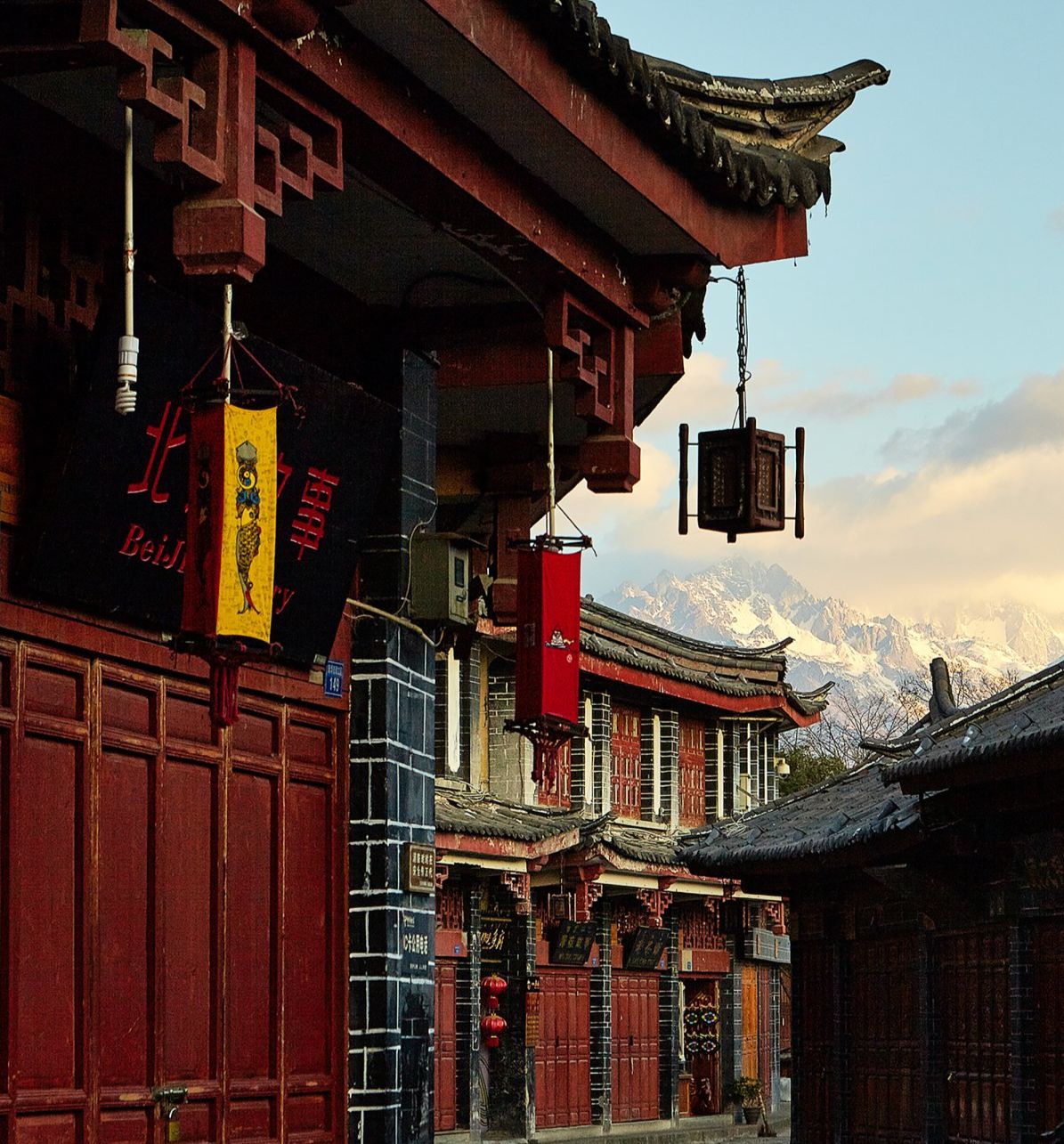
Drive to Lijiang (UNESCO), home of the Naxi people, renowned for its preserved old town. Stop at the spectacular Tiger Leaping Gorge, carved by the Yangtze River as it descends from Tibet. Visit Shigu Village, where the river forms a dramatic horseshoe bend—the First Great Bend of the Yangtze. Arrival in Lijiang. Walk through Dayan Old Town and climb to Wangu Pavilion on Lion Hill for panoramic views.Day 13 Lijiang
Visit the Mu Family Residence (Mufu), former palace of the Mu governors during the Yuan, Ming, and Qing dynasties. Visit Black Dragon Pool Park and the Dongba Museum, dedicated to Naxi shamanistic culture. Explore Baisha Village and its famous 15th–16th century frescoes, reflecting the religious diversity of the period. Visit Yuhu Village, with its distinctive “monkey-head” stone houses, and meet a Naxi family. Enjoy hands-on experiences: traditional soy milk making, tasting local snacks, initiation into Dongba pictographic writing, and trying on traditional Naxi costumes—an enriching immersion into this matriarchal society.
Day 14 Lijiang → Paris
Free morning to explore Lijiang at your own pace. After lunch, farewell to this remarkable land.
Transfer to Lijiang Airport in the late afternoon, assistance with check-in. Flight to Paris with one stopover. (Breakfast, Lunch included)
Free morning to explore Lijiang at your own pace. After lunch, farewell to this remarkable land.
Transfer to Lijiang Airport in the late afternoon, assistance with check-in. Flight to Paris with one stopover. (Breakfast, Lunch included)
Day 15 Paris
Overnight flight. Arrival in Paris in the morning.